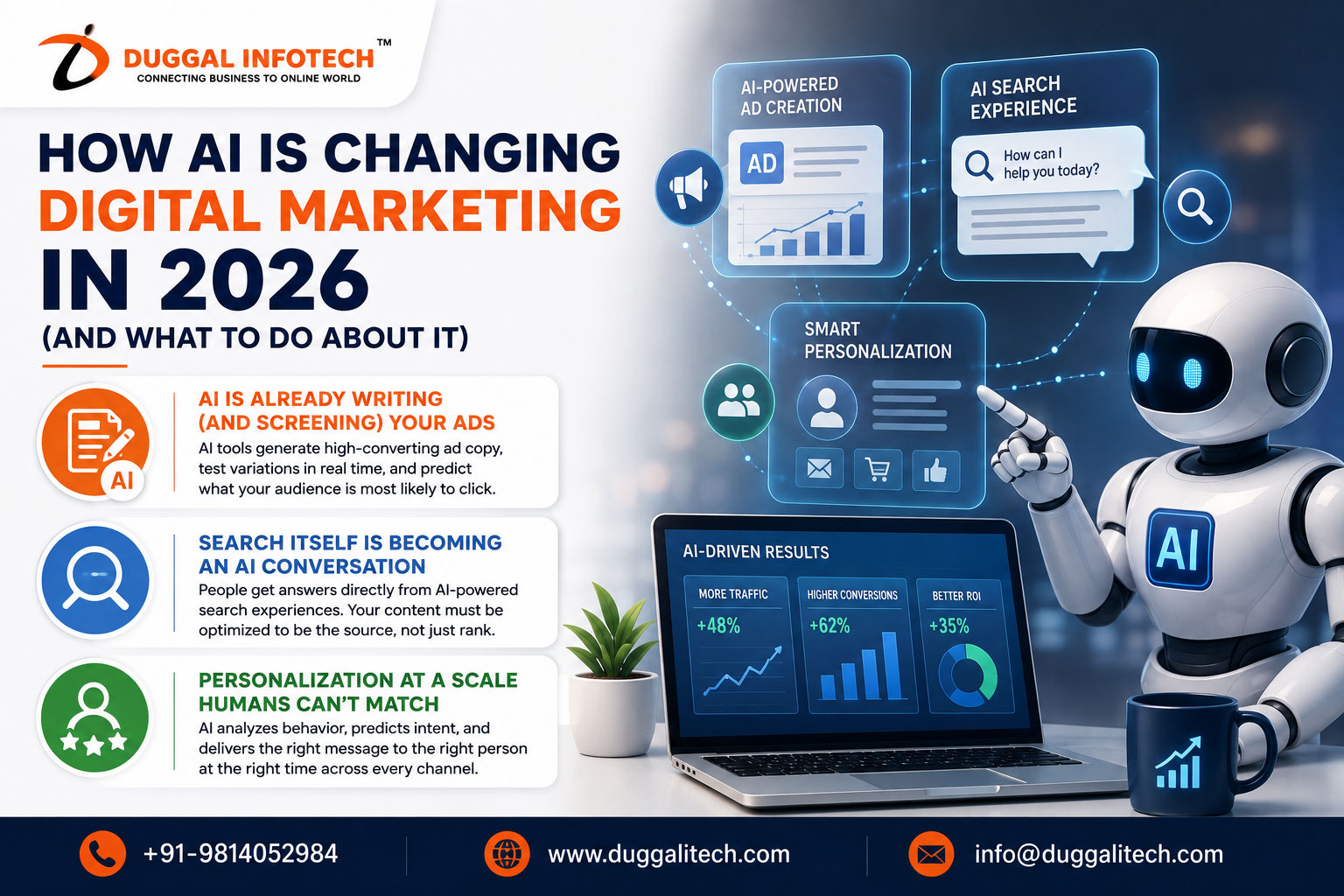
 AI is changing digital marketing faster than almost any shift that’s come before it — not as a future prediction, but as something already reshaping how ads get built, how people search, and what customers expect from a brand’s response time. Here’s what’s actually different in 2026, and what a business should do about each change.
AI Is Already Writing (and Screening) Your Ads
Ad platforms now generate headline and creative variations automatically, test them against each other in real time, and shift budget toward whatever performs best — often faster than a human manager could react. This doesn’t remove the need for strategy; it raises the bar on it. The businesses winning here are the ones feeding these systems clear brand guidelines and strong source material, not the ones leaving everything to full automation.
Search Itself Is Becoming an AI Conversation
A growing share of searches are answered directly by AI-generated summaries instead of a list of links, and more people are asking AI assistants questions they’d previously have typed into Google. That means visibility now depends on being the kind of clear, well-structured, genuinely useful source these systems pull from and cite — not just ranking a traditional blue link. We cover this in more depth in our guide to AI Optimization (AIO).
Personalization at a Scale Humans Can’t Match
AI-driven segmentation can now tailor email content, product recommendations, and on-site experiences to individual behavior in real time, at a scale no manual campaign could replicate. Customers increasingly expect this — generic, one-size-fits-all messaging reads as dated. Businesses that adopt even basic AI-driven personalization in email and on-site recommendations tend to see meaningfully better engagement than those still sending the same message to everyone.
Frequently Asked Questions
Will AI replace digital marketers?
Unlikely in the near term. AI is replacing specific repetitive tasks ad variation testing, basic personalization but strategy, brand judgment, and reviewing AI output still need a person.
What is AI Optimization (AIO)?
AIO is the practice of structuring content so AI systems like Google’s AI Overviews and AI assistants can easily extract and cite it, similar to how SEO optimizes for traditional search rankings.
Do small businesses need AI tools, or is this just for large companies?
Most ad platforms and email tools already include AI features by default at no extra cost, so small businesses are often already using basic AI marketing tools without a separate investment.
How do I make sure AI-generated content doesn’t hurt my brand?
Keep a human reviewing anything AI generates before it goes live, and feed these tools clear brand guidelines and real source material rather than leaving output entirely automated.
How AI Is Changing Digital Marketing: What This Means for Your Business
You don’t need to overhaul everything at once. The practical starting points are usually:
- Use AI tools to speed up ad variation testing, not replace strategic decisions about what to test
- Write content clearly enough that both people and AI systems can extract a direct answer near the top
- Add basic personalization to email and product recommendations if you haven’t already — most platforms now offer this natively
- Keep a human reviewing AI-generated content and ad copy before it goes live — speed is only useful if quality holds
The businesses that treat AI as a tool that makes good strategy faster — not a replacement for having one — are the ones pulling ahead in 2026. If you want help figuring out where AI actually fits in your marketing, our digital marketing services or a free consultation are good places to start.