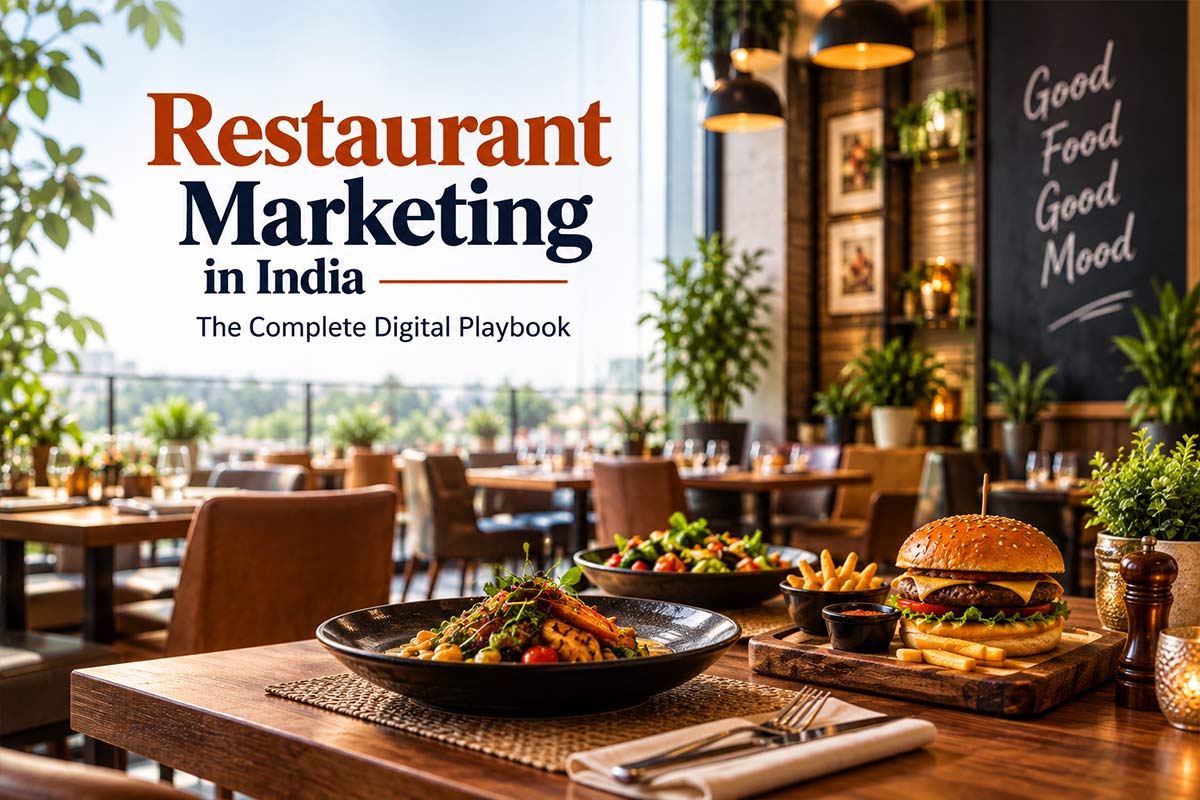
 Restaurant marketing in India has moved online. Before choosing where to eat or order from, most customers now search Google Maps, scroll through Instagram, check reviews, and compare menus on their phone. This playbook shows restaurants, cafes, dhabas, sweet shops, and cloud kitchens exactly how to use restaurant digital marketing to fill more tables, win more direct orders, and depend less on delivery app commissions.
What Is Restaurant Marketing?
Restaurant marketing is everything a restaurant does to attract new diners and bring existing customers back. Today, most of it happens online: appearing on Google Maps, posting food photos and Reels on Instagram, collecting reviews, running local ads, and staying in touch with regulars on WhatsApp. Restaurant digital marketing simply means doing these things in a planned, measurable way.
Why Restaurants in India Need Digital Marketing
India’s food services industry is large and growing fast. According to the National Restaurant Association of India’s India Food Services Report 2024, the sector is valued at ₹5.69 lakh crore and is expected to reach ₹7.76 lakh crore by 2028, growing at 8.1% a year. The report also projects that India will become the world’s third-largest food services market by 2028, overtaking Japan (source: Mediabrief, NRAI IFSR 2024).
More growth also means more competition. New cafes, cloud kitchens, and chains open every month, and they all compete for the same customers on the same apps and the same Google Maps results. The restaurants that stay busy are usually the ones customers can easily find, trust from their reviews, and remember from social media.
The Delivery App Problem: Why Direct Orders Matter
Swiggy and Zomato are great for discovery, but they are expensive. For a typical single-outlet or small restaurant, commission usually runs around 25-27% of the order value, while larger chains with around ten or more outlets can often negotiate it down to roughly 18-22% (source: Restaurant Coach). Ads, discounts, and other charges on the platforms can push the real cost even higher.
That does not mean you should leave the apps. It means you should use them to be discovered, and then use your own channels, such as your website, Google profile, and WhatsApp, to turn first-time customers into regulars who order directly. Every order that comes directly to you instead of through an app keeps more money in your business.
9 Restaurant Digital Marketing Strategies That Work
- Optimise your Google Business Profile. This is the most important step for any restaurant. Choose the right category, add your menu, opening hours, phone number, and plenty of real food and interior photos. Google’s own tips to improve your local ranking are a good checklist.
- Collect and reply to reviews. Diners choose restaurants based on ratings. Ask happy customers for a Google review with a small table card or QR code, and reply politely to every review, especially the negative ones.
- Build a simple restaurant website. Include your menu, photos, location map, timings, a call button, and a WhatsApp or direct ordering link. It gives customers a commission-free way to order and book.
- Post Reels and food videos on Instagram. Food is one of the most visual things on social media. Short videos of dishes being cooked, plated, or served are the fastest way to get noticed by new customers nearby.
- Run local ads around your restaurant. Instagram and Facebook ads can target people within a few kilometres of your outlet, and Google Ads can show you to people searching for food in your area right now.
- Use WhatsApp for direct orders and regulars. Share your menu, take orders, confirm table bookings, and send weekend specials to customers who have opted in.
- Keep your delivery app listings sharp. Good photos, clear descriptions, and accurate timings improve how you rank inside Swiggy and Zomato too.
- Plan around festivals and events. Diwali sweets, Lohri and Baisakhi celebrations, wedding season catering, and cricket match nights are all chances to run timely offers.
- Work with local food creators. A visit from a well-matched local food blogger or Instagram creator can bring in a wave of new customers, often for far less than traditional advertising.
Restaurant Marketing Ideas by Type of Business
- Family restaurants and dhabas: focus on Google Maps, reviews, and photos of generous portions. Highway dhabas should make sure their location and opening hours are accurate for travellers searching on the road.
- Cafes: Instagram is your storefront. Post your space, signature drinks, and events, and encourage customers to tag you.
- Cloud kitchens: with no dine-in, your delivery app listings, Instagram, and repeat orders on WhatsApp do all the work. Build a list of regulars early.
- Sweet shops and bakeries: festival pre-orders and gift boxes are your biggest opportunity. Start promoting them a few weeks before Diwali, Rakhi, and wedding season.
- Fine dining: invest in professional photos, a polished website with table booking, and a steady flow of detailed reviews that mention the experience.
If your restaurant also serves tourists, our guide to digital marketing for hotels and guesthouses covers how to reach visitors during peak tourism season.
A Simple Monthly Restaurant Marketing Plan
| Task | How Often |
|---|---|
| Post on Instagram and Facebook (at least one Reel) | 3-4 times a week |
| Add new photos and a post to Google Business Profile | Weekly |
| Reply to every Google and delivery app review | Daily or every few days |
| Send a WhatsApp offer to opted-in regulars | Once a week at most |
| Review ad results and adjust budget | Weekly |
| Plan next month’s festival or event offers | Monthly |
How Much Should a Restaurant Spend on Marketing?
There is no single right number, because a small dhaba and a large cafe chain have very different budgets. A practical approach is to start with the free basics, including your Google Business Profile, reviews, and regular social media posts, and then add a modest monthly budget for local Instagram, Facebook, or Google ads once those basics are in place.
Judge your spending by results, not clicks: how many new customers, direct orders, or table bookings each rupee brings in. For typical ad costs, see our guide to Instagram and Facebook ads cost in India. Food and beverage is one of the more affordable categories to advertise in.
Common Restaurant Marketing Mistakes
- Wrong or missing opening hours on Google. Nothing loses a customer faster than arriving at a closed restaurant.
- Using only stock photos. Customers want to see your real food and your real space.
- Ignoring negative reviews. A calm, helpful reply often matters more to new customers than the complaint itself.
- Relying only on delivery apps. Without your own channels, every repeat order still pays full commission.
- Posting only discounts. Constant offers can cheapen your brand. Mix in stories about your chef, ingredients, and customers.
- Inconsistent posting. A burst of posts followed by months of silence makes a restaurant look closed.
How to Measure Your Restaurant Marketing
Track a few simple numbers every month:
- Google Business Profile calls, direction requests, and website clicks
- New reviews and your average rating
- Direct orders and table bookings from your website and WhatsApp
- Delivery app orders and the share of repeat customers
- Ad spend compared with the new orders it produced
How Duggal Infotech Helps Restaurants Grow
We help restaurants, cafes, dhabas, sweet shops, and cloud kitchens across Amritsar and Punjab get found, get chosen, and get more direct orders:
- Restaurant website design with menus, photos, maps, and direct ordering or booking.
- Google Business Profile SEO and local SEO so you show up on Google Maps.
- Instagram Ads, Facebook Ads, and Google Ads targeted to customers near your outlet.
- Social media marketing and social media design for food posts, Reels, and festival campaigns.
- WhatsApp marketing for direct orders and loyal customers.
Want to do it yourself first? Start with our guides on ranking on Google Maps, getting more Google reviews, WhatsApp marketing, and AI video ads for small businesses, or see our full digital marketing services.
Frequently Asked Questions
What is restaurant marketing?
Restaurant marketing is everything a restaurant does to attract new diners and bring regulars back, including its Google Maps listing, reviews, social media, website, ads, and WhatsApp communication with customers.
What is the best digital marketing strategy for a restaurant?
Start with a complete Google Business Profile and genuine reviews, since that is where most local diners search first. Then add regular Instagram Reels, a simple website with your menu, and WhatsApp for direct orders.
How can a restaurant get more customers from Google?
Keep your Google Business Profile accurate and active: correct category, menu, hours, real photos, regular posts, and plenty of recent reviews with thoughtful replies.
Is Instagram good for restaurant marketing?
Yes. Food is highly visual, so Instagram Reels and photos are one of the most effective ways for restaurants to reach new customers nearby and stay top of mind with regulars.
How much commission do Swiggy and Zomato charge?
For a typical single-outlet or small restaurant, commission is usually around 25-27% of the order value, while larger chains can often negotiate it down to roughly 18-22%. Ads and other charges can add to the total cost.
How can restaurants reduce dependence on delivery apps?
Use the apps for discovery, but build your own channels for repeat orders: a website with direct ordering, a Google Business Profile with an order link, and a WhatsApp list of regular customers.
How much should a restaurant spend on marketing?
It depends on size and goals. Start with free basics like Google Business Profile, reviews, and regular posts, then add a modest local ad budget and judge it by the new orders and bookings it brings in.
Do restaurants need a website if they are on Zomato and Swiggy?
Yes. A website gives customers a commission-free way to see your menu, order, or book a table, and it builds trust with diners who search for your restaurant by name.
Should restaurants work with food bloggers and influencers?
It can work well, especially with local food creators whose followers live near your restaurant. Choose creators whose audience matches your customers rather than those with the biggest follower count.