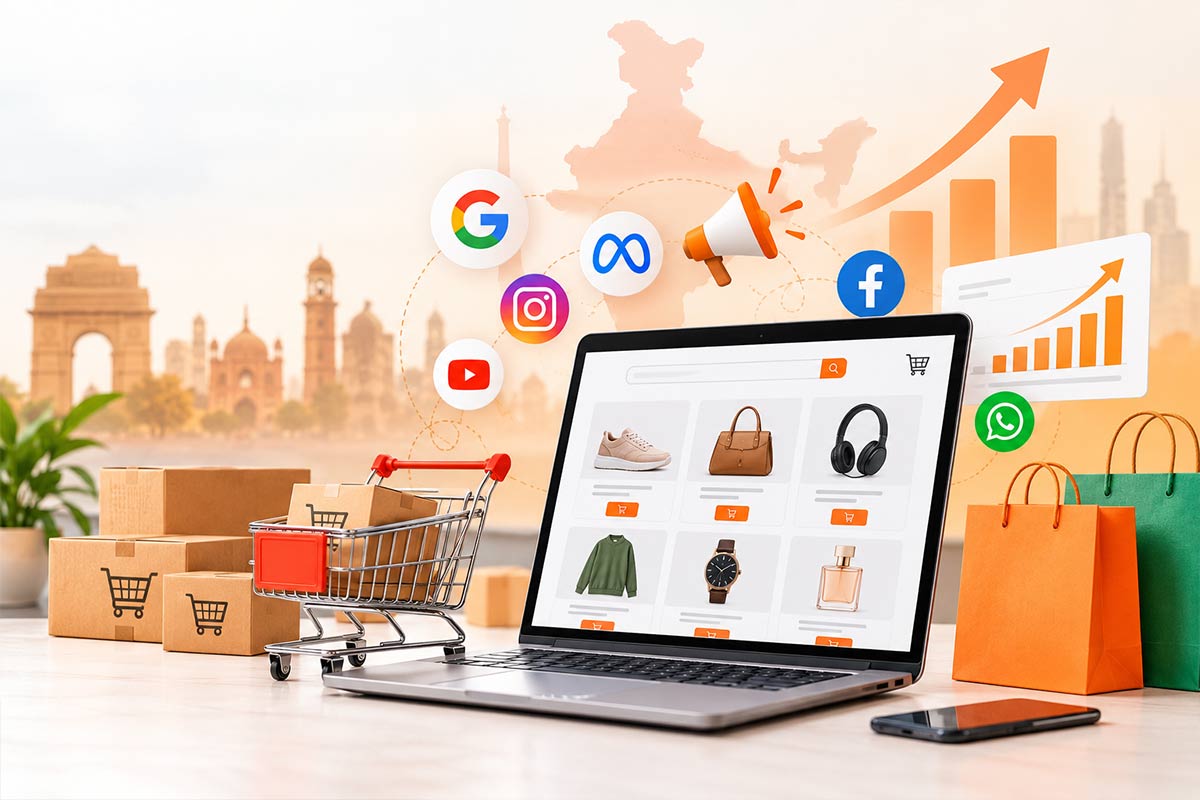
 Selling online in India has never been easier to start, or harder to win. A store can go live in a week. Getting steady orders is another matter. This playbook explains digital marketing for e-commerce brands in India, step by step. It covers the channels that drive sales, how to split your budget and the numbers you should track.
It is written for D2C founders, small online stores and retailers moving their shop online. You do not need a big budget to use it. You need a clear plan and the discipline to measure what works.
Why Digital Marketing for E-commerce Needs Its Own Playbook
The Indian online market is large and still growing fast. According to IBEF’s e-commerce industry report, the market was worth about US$ 125 billion in 2024 and is projected to reach US$ 345 billion by 2030. The same report says India had nearly 290 to 300 million online shoppers in 2025.
Growth is also shifting away from big metros. IBEF notes that Tier-2 and smaller cities contributed about 65% of new shoppers. That matters for brands in Punjab. Your next customer may be in Bathinda or Hoshiarpur, not only in Delhi.
Reach is huge too. DataReportal’s Digital 2026 India report counts 1.03 billion internet users and an Instagram ad reach of 481 million in late 2025. The audience is there. The challenge is reaching the right part of it at a cost that leaves you a profit.
Start With the Numbers: Margin, AOV and CAC
Many stores start ads before they know what a customer is worth. That is the fastest way to lose money. Work out three numbers first.
- Gross margin: what you keep from each sale after product cost, packaging and shipping.
- Average order value (AOV): the average amount a customer spends per order.
- Customer acquisition cost (CAC): what you spend in marketing to win one new buyer.
If your margin on a ₹1,000 order is ₹300, you cannot spend ₹400 to get that order and survive. You either raise AOV with bundles, lower CAC with better targeting, or rely on repeat purchases. Every decision below flows from this.
The Core Channels in Digital Marketing for E-commerce
1. Your website and product pages
Every other channel sends people here, so it must convert. Use fast-loading pages, clear photos, honest delivery times, easy returns and UPI at checkout. Our e-commerce website design guide covers the essentials. If you need a new store, see our e-commerce development service.
2. Google Shopping and Search ads
Shopping ads show your product photo, price and store name when someone searches for that item. Buyers who search are often ready to purchase. Google also lets merchants show products in free listings through Google Merchant Center. Start with our Google Shopping ads setup guide or our managed Google Shopping ads service.
3. Meta ads on Instagram and Facebook
Meta ads create demand. They reach people who were not searching but may love your product. Short videos, product demos and customer unboxings usually work best. For realistic budgets, read our Instagram and Facebook ads cost guide.
4. SEO for categories and products
Organic search brings orders without a cost per click. Focus on category pages first, such as “cotton kurtas for women”, then on product pages and buying guides. Write unique descriptions instead of copying the manufacturer’s text. Our SEO services page explains our approach.
5. WhatsApp and email for repeat sales
A repeat buyer costs far less than a new one. Use WhatsApp for order updates, back-in-stock alerts and festive offers, with clear opt-in. Use email for new arrivals and loyalty rewards. See our WhatsApp marketing guide and email marketing service.
6. Influencers and user content
Real people using your product build trust faster than polished ads. Micro-influencers in your niche are often better value than big names. Our guide to influencer marketing in India explains how to start and how to stay compliant.
How to Split Your E-commerce Marketing Budget
There is no single right split. It depends on your product, margin and stage. The table below is a common starting point we use when planning, not a fixed rule.
| Stage | Where most budget goes | Why |
|---|---|---|
| Launch (0–6 months) | Meta ads and Google Shopping | You need early sales and data quickly |
| Growth (6–18 months) | Shopping, search, remarketing, influencers | Scale what works and capture demand |
| Mature (18+ months) | SEO, WhatsApp, email and loyalty | Lower CAC and grow repeat orders |
Keep a small test budget, around one tenth of spend, for new ideas. Move money towards whatever gives the best return each month.
How to Launch an E-commerce Marketing Plan: Step by Step
- Fix your numbers. Calculate gross margin, average order value and the highest acquisition cost you can afford.
- Set up tracking. Install Google Analytics, the Google Ads tag and the Meta pixel, and test that purchases are recorded.
- Prepare your product feed. Upload accurate titles, prices, stock and images to Google Merchant Center.
- Launch Shopping and Meta campaigns. Start with your best-selling products and a modest daily budget.
- Add remarketing. Show ads to people who viewed products or left items in the cart.
- Collect reviews and opt-ins. Ask every buyer for a review and permission to send WhatsApp or email updates.
- Review weekly and scale. Cut products and ads with poor return, and raise budgets on the winners.
Key Metrics Every E-commerce Brand Should Track
| Metric | What it tells you |
|---|---|
| ROAS | Revenue earned for every rupee spent on ads |
| CAC | The cost of winning one new customer |
| Conversion rate | How many visitors place an order |
| Cart abandonment rate | How many shoppers leave before paying |
| Repeat purchase rate | How many customers come back |
| Return and RTO rate | How many orders come back or fail delivery |
The last metric is often ignored. Cash-on-delivery orders that are refused at the door cost you shipping both ways. If returns are high, check product photos, sizing charts and COD confirmation calls before spending more on ads.
Marketplaces or Your Own Website?
Many Indian brands sell on Amazon, Flipkart or Meesho as well as on their own site. Both have a place in digital marketing for e-commerce, but they do different jobs.
| Point | Marketplace | Own website |
|---|---|---|
| Ready traffic | Yes, buyers are already there | No, you must bring visitors |
| Fees | Commission and fees on each sale | Payment gateway and hosting costs |
| Customer data | Mostly kept by the marketplace | Yours to use for repeat sales |
| Brand control | Limited design and messaging | Full control of the experience |
A sensible approach is to use marketplaces for reach and your own website for profit and loyalty. Put a small card in every marketplace parcel that invites buyers to your website or WhatsApp channel for future offers, where the marketplace’s rules allow it.
Plan Around India’s Sale Seasons
Online demand in India rises sharply around festivals and big sale events. Diwali, wedding season and end-of-season sales can bring a large share of yearly orders in a few weeks. Ad costs can rise at the same time, because many brands compete for the same buyers.
- Build your audience early. Grow followers, email and WhatsApp lists a month before the season.
- Stock your best sellers. Running out of stock while ads are live wastes money.
- Prepare creatives in advance. Make festive banners and videos before the rush.
- Use remarketing heavily. Visitors from earlier months are your cheapest festive buyers.
Our Diwali marketing ideas post has a ready checklist you can adapt for any festival.
Common E-commerce Marketing Mistakes
- Judging ads on clicks. Only purchases and profit matter.
- Sending all traffic to the home page. Send ad clicks to the exact product or category.
- Ignoring mobile speed. Slow pages lose buyers before they see the product.
- Using misleading AI images. AI backgrounds are fine, but the product must look real. Read our guide to AI-generated product images.
- Forgetting existing customers. A store that only chases new buyers pays the highest possible cost per sale.
Should You Hire an E-commerce Marketing Agency?
You can manage the basics yourself while orders are small. Once you spend more on ads every month, daily optimisation and good creative make a big difference. That is when a specialist team usually pays for itself. Read what a performance marketing agency does before you decide.
Frequently Asked Questions
What is digital marketing for e-commerce?
Digital marketing for e-commerce is the use of online channels such as Google Shopping, Meta ads, SEO, WhatsApp, email and influencers to bring shoppers to an online store and turn them into repeat buyers.
Which channel is best for a new online store in India?
Most new stores start with Meta ads to build demand and Google Shopping to capture people already searching. Add remarketing, WhatsApp and SEO once you have early sales and data.
How much should an e-commerce brand spend on marketing?
Base your budget on margin, not on a fixed percentage. Work out the most you can spend to win a customer and still make a profit, then set daily budgets that stay under that limit.
What is a good ROAS for e-commerce?
It depends on your margin. A low-margin product needs a much higher ROAS to stay profitable than a high-margin one. Calculate your break-even ROAS from your own costs first.
Is SEO worth it for an online store?
Yes. SEO takes longer than ads, but category and product pages that rank can bring orders for years without a cost per click. It works best alongside paid campaigns.
How do I reduce cart abandonment?
Show delivery charges early, offer UPI and cash on delivery where sensible, keep checkout short and use remarketing ads or WhatsApp reminders for shoppers who leave.
Final Word
Good digital marketing for e-commerce is not about being on every channel. It is about knowing your numbers, choosing the right channels for your stage and improving every week. Start small, track every order and scale only what earns a profit.
Want help growing your online store? Explore our digital marketing services or contact Duggal Infotech in Amritsar for a free store and ads review.