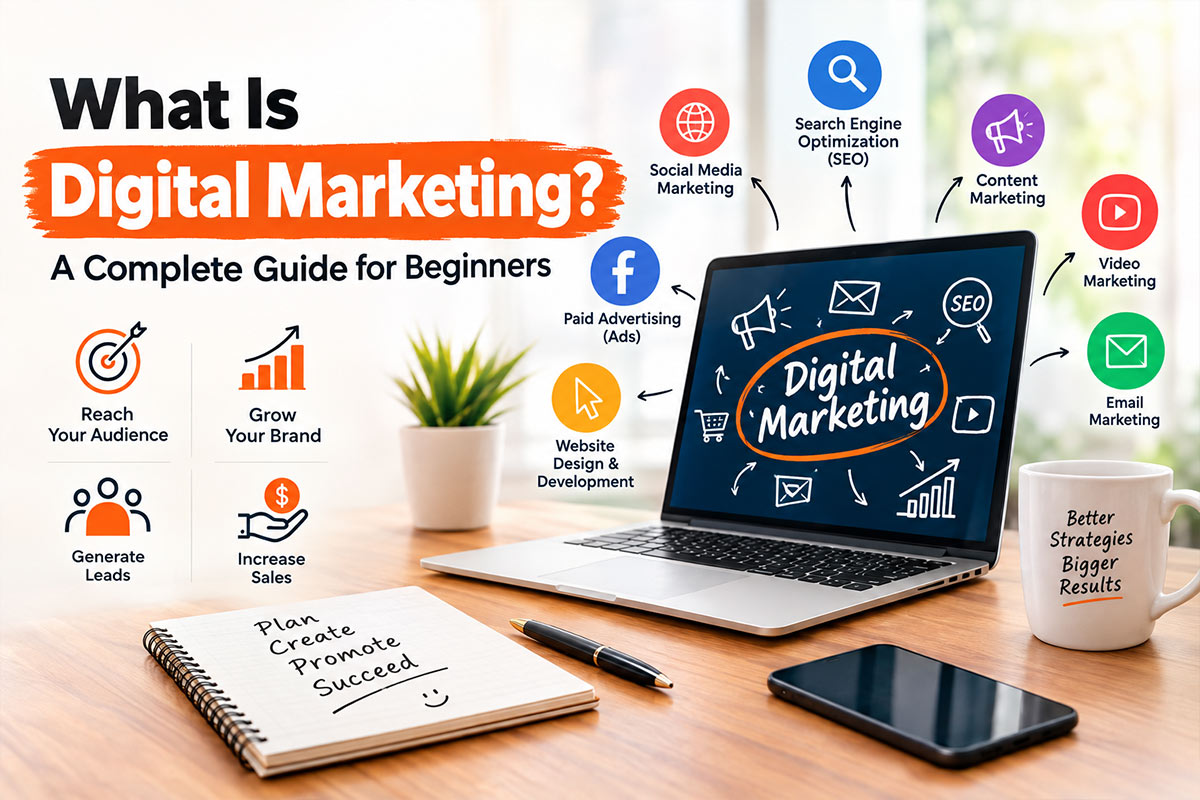
 Digital marketing is the practice of promoting products, services, or brands using online channels such as search engines, social media, email, and paid advertising, rather than traditional offline channels like print, TV, or radio. It covers everything from a blog post that ranks on Google to a Google Ads campaign, an Instagram post, or a newsletter that lands in your inbox.
If you are new to the topic, digital marketing can feel like a moving target — new platforms, new AI-powered tools, and new terminology appear every year. This guide breaks it down from first principles: what digital marketing actually means, its core fundamentals, the main types you will come across, how a strategy is actually built, and why it matters for businesses in India specifically. By the end, you will have a clear map of the whole discipline rather than a list of buzzwords.
What Is Digital Marketing?
Digital marketing is any marketing effort that uses an internet-connected device or channel to reach an audience. That includes search engines (Google, Bing), social platforms (Instagram, Facebook, LinkedIn), email, websites, mobile apps, and increasingly, AI-powered search tools like Google’s AI Overviews and chatbots such as ChatGPT and Gemini. The goal is the same as any form of marketing — building awareness, generating leads, and driving sales — but digital marketing lets businesses target specific audiences, measure results precisely, and adjust campaigns in real time in a way traditional media cannot.
A useful way to think about it: traditional marketing broadcasts a message to a broad audience and hopes it lands. Digital marketing targets a defined audience, tracks exactly how they respond, and lets you improve the campaign while it is still running.
The Fundamentals of Digital Marketing
Every digital marketing effort, regardless of channel, rests on the same handful of fundamentals:
- Audience definition. Knowing who you are trying to reach — their demographics, interests, and the problems they are trying to solve — before you choose a channel or write a single word of copy.
- The marketing funnel. Most digital marketing maps to three stages: awareness (someone discovers your brand), consideration (they compare you to alternatives), and decision (they buy or convert). Different channels and content types suit different stages.
- Channels. The specific platforms and methods used to reach your audience — search engines, social media, email, and paid ads being the most common (covered in detail below).
- Content. The actual material — blog posts, videos, ad creative, social posts, emails — that carries your message through those channels.
- Measurement. Digital marketing’s biggest advantage over traditional marketing is that almost everything is trackable: traffic, clicks, conversions, cost per lead, and return on ad spend can all be measured and used to improve future campaigns.
Understanding these fundamentals matters more than memorising platform-specific tactics, because platforms change constantly while these underlying principles do not.
Paid, Organic, and Earned Media: The Three Ways Digital Marketing Works
Beyond the fundamentals above, it helps to understand the three broad categories every digital marketing channel falls into:
- Paid media. Any channel where you pay directly for visibility — Google Ads, Meta Ads, sponsored social posts, and display advertising. Paid media delivers fast, controllable results but stops the moment you stop paying.
- Organic media. Visibility you earn without paying per click or impression — SEO rankings, organic social media posts, and content that ranks or gets shared naturally. Organic results take longer to build but keep working with far lower ongoing cost.
- Earned media. Exposure generated by others talking about your brand — reviews, press mentions, backlinks from other websites, and word-of-mouth shares. Earned media is the hardest to control directly but often carries the most trust with an audience.
A mature digital marketing strategy usually blends all three: paid media for immediate results, organic media for long-term compounding growth, and earned media as a byproduct of doing good work consistently.
Digital Marketing vs Online Marketing: Are They the Same?
In practice, yes. Online marketing and digital marketing are used interchangeably by most marketers and businesses. Technically, “digital marketing” is the broader term, since it can include offline digital channels too, such as digital billboards, SMS marketing, or in-app advertising that does not require an active internet connection at the moment it is displayed. “Online marketing” refers more narrowly to marketing that happens over the internet specifically. For nearly all practical purposes — including everything covered in this guide — the two terms describe the same set of activities.
Types of Digital Marketing
Digital marketing is not one activity but a collection of distinct disciplines, each with its own skills and tools. The main types are:
- Search Engine Optimization (SEO). Improving a website so it ranks higher in organic (unpaid) search results, driving free, ongoing traffic over time.
- Pay-Per-Click Advertising (Google Ads). Paying to place ads at the top of search results or across websites and apps, charged each time someone clicks.
- Social Media Marketing. Building a brand presence and running organic or paid campaigns on platforms like Instagram, Facebook, and LinkedIn.
- Content Marketing. Creating blog posts, guides, videos, and other material designed to attract and educate an audience rather than directly sell to them.
- Email Marketing. Sending newsletters, promotions, and automated sequences directly to a subscriber’s inbox — still one of the highest-ROI digital channels.
- Affiliate and Influencer Marketing. Partnering with other websites, creators, or influencers who promote your product in exchange for a commission or fee.
- AI Optimization (AIO) and Generative Engine Optimization (GEO). The newest type of digital marketing — optimizing content so it gets cited and recommended by AI-powered search tools like Google’s AI Overviews, ChatGPT, and Gemini, rather than only ranking in traditional blue-link results.
Most businesses do not use all of these at once. A well-built strategy picks two or three that match the business’s goals and budget, rather than spreading effort thin across every channel.
How to Build a Digital Marketing Strategy in 5 Steps
- Set a specific, measurable goal. “More leads” is not a strategy. “20 qualified leads per month from Amritsar and nearby cities” is something you can actually plan and measure against.
- Define your target audience. Identify who you are trying to reach, what they search for, and which platforms they actually spend time on.
- Choose the right channels. Match channels to your goal and audience — SEO and content for long-term organic growth, Google Ads for immediate visibility, social media for brand awareness and engagement.
- Create and publish consistently. A strategy only works if it is executed consistently over months, not as a one-off burst of activity.
- Measure results and adjust. Track what is actually working using analytics, then shift budget and effort toward the channels and content producing real results.
A digital marketing strategy is never really “finished” — it is a cycle of planning, executing, measuring, and refining that continues for as long as the business is actively marketing itself.
Digital Marketing Kya Hai?
Digital marketing ek aisi marketing technique hai jisme businesses apne products ya services ko online channels — jaise Google search, social media (Instagram, Facebook), email, aur paid ads — ke through promote karte hain. Traditional marketing (newspaper, TV, radio) ke muqable digital marketing zyada targeted hoti hai, aur iske results (clicks, leads, sales) ko track karna aasan hota hai.
Digital marketing ke main types hain: SEO (Google par ranking improve karna), Google Ads (paid advertising), social media marketing, content marketing, aur email marketing. Small businesses ke liye digital marketing local customers tak pahunchne ka sabse affordable aur measurable tareeka hai — chahe wo Amritsar ho ya India ke kisi bhi shehar mein.
Why Digital Marketing Matters for Businesses in India
India’s digital advertising market is projected to grow 10.1% in 2026 to reach $14.56 billion, according to a PayNXT360 report cited by Indian Television Dot Com, with growth increasingly driven by regional-language content, connected TV, and creator-led campaigns rather than only traditional search and display ads. For businesses in Amritsar and across Punjab, this shift matters directly: customers are searching in both English and Hindi/Punjabi, discovering businesses through Google Business Profiles and social media as often as through a website, and increasingly getting answers from AI-powered search tools before they ever click a traditional search result. A business that only relies on word-of-mouth or a static website is competing at a real disadvantage against local competitors who have invested in SEO, Google Ads, and social media.
How Duggal Infotech Can Help You with Digital Marketing
If you are ready to move from understanding digital marketing to actually doing it, Duggal Infotech works as a full-service digital marketing agency in Amritsar, building custom strategies across SEO, Google Ads, social media, and AI Optimization rather than pushing a one-size-fits-all package. If you are currently comparing options, our guides on what a digital marketing agency actually costs and the common mistakes businesses make when hiring one are a good next read before you commit to any provider.
Frequently Asked Questions
What is digital marketing in simple words?
Digital marketing is promoting a business online using channels like search engines, social media, email, and paid ads, instead of only traditional channels like print, TV, or radio.
What are the main types of digital marketing?
The main types are SEO, pay-per-click (Google Ads) advertising, social media marketing, content marketing, email marketing, affiliate/influencer marketing, and the newer discipline of AI Optimization (AIO) and Generative Engine Optimization (GEO).
Is digital marketing the same as online marketing?
Yes, in practice the two terms are used interchangeably. Technically “digital marketing” is the slightly broader term, but for almost all real-world purposes they describe the same activities.
What is a digital marketing strategy?
A digital marketing strategy is a plan that defines specific goals, a target audience, the channels used to reach them, and how results will be measured and improved over time. It is not a single tactic but an ongoing, coordinated approach.
Why is digital marketing important for small businesses?
Digital marketing lets small businesses reach a defined local or national audience at a fraction of the cost of traditional advertising, while tracking exactly what is working, which makes it far more accessible than TV or print for most small and mid-sized businesses.
How is digital marketing different from traditional marketing?
Traditional marketing broadcasts a message to a broad, largely untracked audience through channels like TV, radio, or print. Digital marketing targets a defined audience through online channels and provides precise, real-time data on how that audience responds.
What skills does a digital marketer need?
A digital marketer typically needs a working knowledge of SEO, paid advertising platforms like Google Ads, content writing, basic analytics and data interpretation, and increasingly, an understanding of how AI-powered search tools surface and cite content.
Can a small business do digital marketing without hiring an agency?
Yes, especially in the early stages — many small businesses start with basic SEO and social media themselves. As competition increases or paid advertising is added, most businesses eventually bring in an agency or freelancer for the specialised knowledge and time it requires.
How long does it take to see results from digital marketing?
Paid advertising like Google Ads can generate visibility within days, while SEO and content marketing typically take 3–6 months to show meaningful results, since they depend on search engines building trust in a website over time.
Does Duggal Infotech offer a free consultation for digital marketing?
Yes. We review your current online presence and goals first so any recommendation is based on your actual starting point. You can reach out through our contact page to arrange this.