
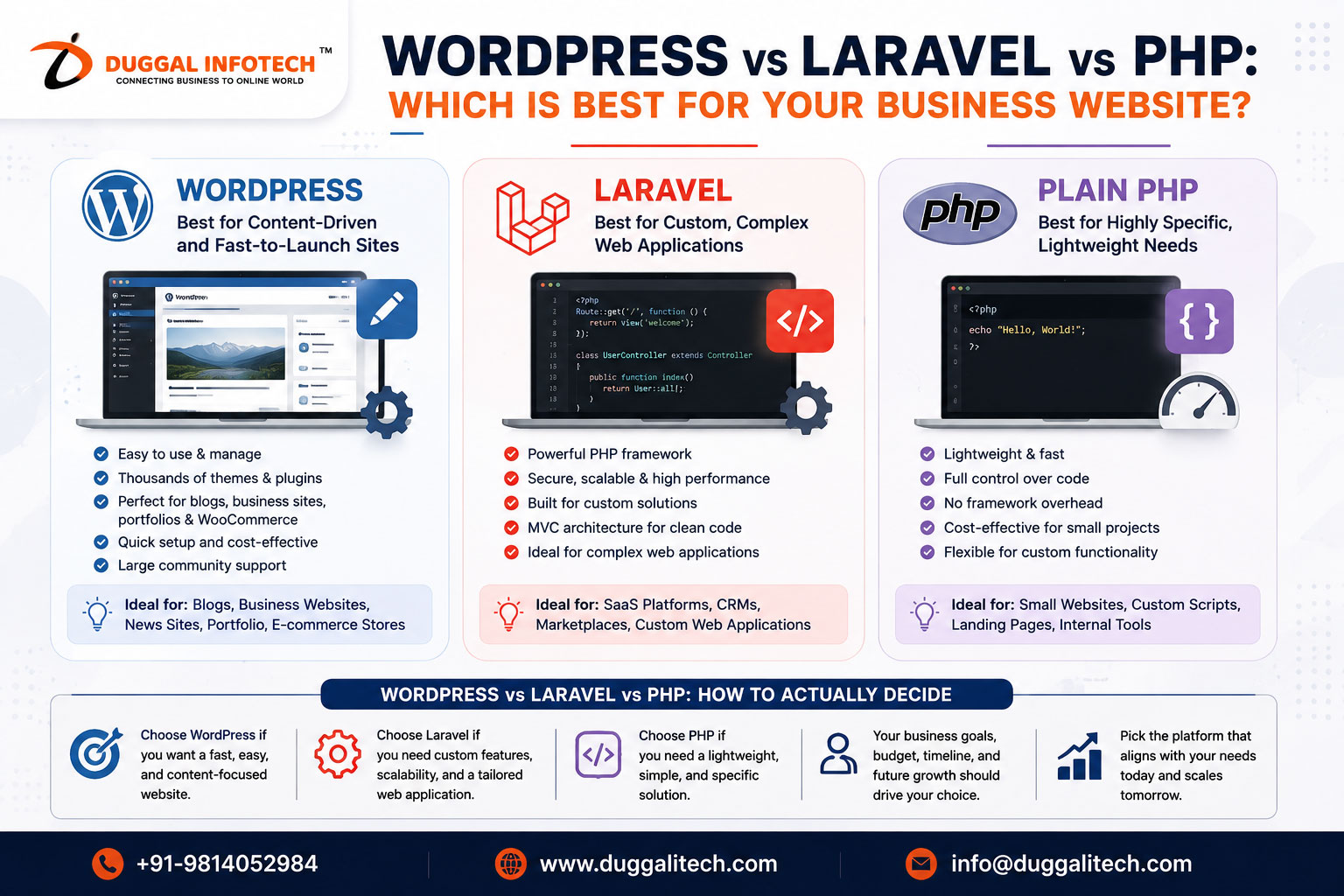
 Choosing a platform is one of the first real decisions in building a business website, and it’s more consequential than it looks — the wrong choice can mean rebuilding from scratch a year or two in. WordPress, Laravel, and plain PHP are three of the most common options, and each is genuinely the right choice for a different kind of business. Here’s a practical WordPress vs Laravel vs PHP comparison to help you tell which one fits yours.
WordPress: Best for Content-Driven and Fast-to-Launch Sites
WordPress powers a large share of the web for good reason: it’s fast to launch, has a massive ecosystem of themes and plugins, and lets non-technical staff update content without touching code. It’s the natural choice for business websites, blogs, portfolios, and most small-to-medium eCommerce stores built on WooCommerce. The tradeoff is that highly custom functionality — complex booking logic, multi-step workflows, tight integrations with internal systems — can mean stacking plugins that eventually slow the site down or conflict with each other.
Laravel: Best for Custom, Complex Web Applications
Laravel is a PHP framework built for developers creating something genuinely custom: a booking platform with unusual rules, a multi-vendor marketplace, an internal dashboard, or an application with logic no plugin was built to handle. It gives developers structure, security features, and tools that make complex applications easier to build and maintain over time. The tradeoff is cost and timeline — a Laravel build is a software project, not a website you can launch in days, and it needs a developer for any future change, not just an admin with a login.
Plain PHP: Best for Highly Specific, Lightweight Needs
Hand-coded PHP without a framework or CMS still has a place: a single-purpose tool, a lightweight internal utility, or a legacy system that predates modern frameworks. It gives full control with no overhead from a framework or CMS you don’t need. For most businesses, though, this option has become the exception rather than the rule — the maintenance burden and lack of structure make it a harder sell than WordPress or Laravel for anything customer-facing.
WordPress vs Laravel vs PHP: How to Actually Decide
Work backward from what the site needs to do, not what’s technically impressive:
- Mostly content, a catalog, or standard eCommerce? WordPress will get you there faster and cheaper, with a team that can update it themselves
- Custom logic no plugin handles well — unusual booking rules, a marketplace, an internal system? Laravel is worth the higher upfront cost
- A narrow, single-purpose tool with no content management needs? Plain PHP can be the leanest option
- Not sure yet, or budget is tight to start? WordPress is almost always the safer first move — it’s easier to migrate specific features to a custom build later than to over-invest in one upfront
Frequently Asked Questions
Is WordPress good enough for a serious business website?
Yes, for the vast majority of business websites. WordPress powers everything from small local business sites to large media publishers; it becomes limiting only when you need highly custom application logic.
Can you migrate from WordPress to Laravel later?
Yes, though it means a rebuild rather than an upgrade. Many businesses start on WordPress and move specific custom features to a Laravel application once the need becomes clear, rather than over-building upfront.
Is Laravel more secure than WordPress?
Both can be built securely. WordPress’s risk usually comes from outdated plugins rather than the core platform; Laravel gives developers more direct control but requires that control to be used well.
Which option is cheaper to build?
WordPress is almost always cheaper and faster to launch. Laravel and custom PHP cost more upfront because you’re paying for custom development rather than configuring existing tools.
Most businesses that ask this question are better served by WordPress than they expect, and the ones that genuinely need Laravel usually already know it from the complexity of what they’re trying to build. If you’re weighing this decision for your own business, our team builds on both — see our PHP web development services or website design and development services, or get in touch and we’ll help you figure out which fits.