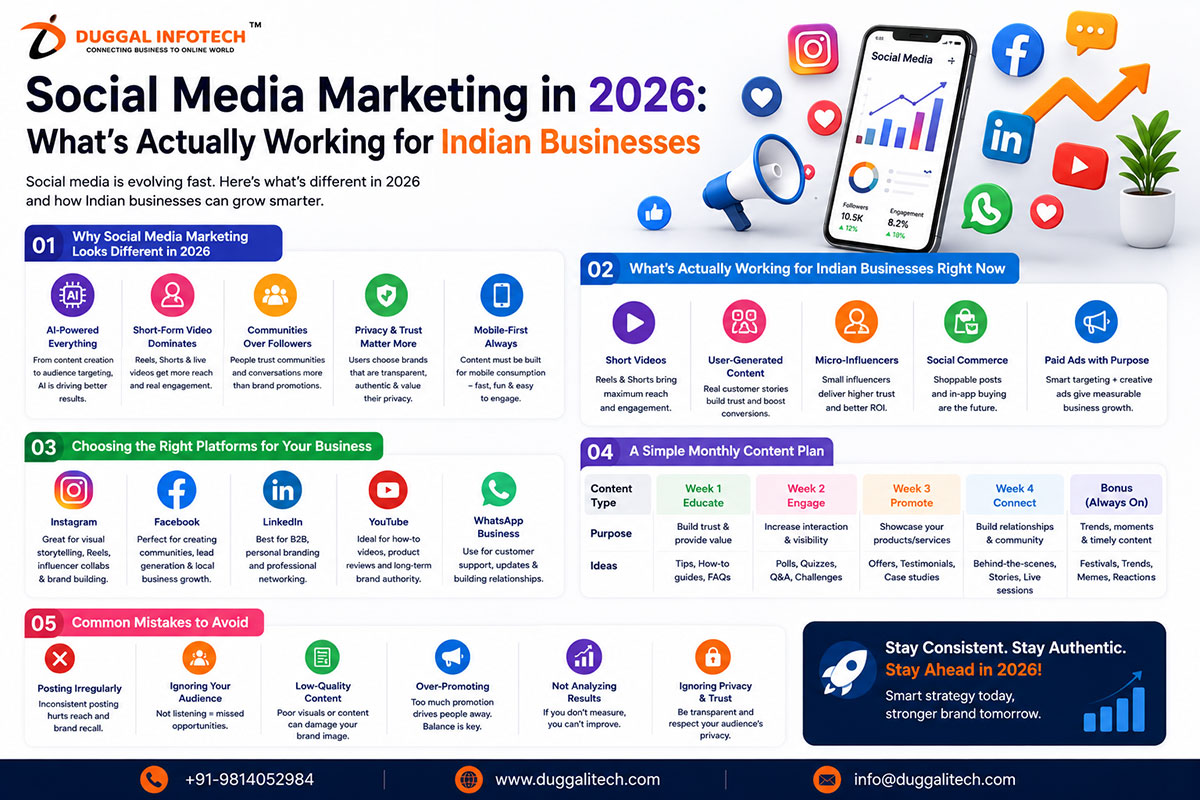
 In short: in 2026, social media marketing in India is working best when it’s consistent, short-form, and platform-specific — Instagram Reels for discovery, WhatsApp for direct communication, and genuine community engagement over polished, one-off campaigns. This guide breaks down what’s actually driving results for Indian businesses right now, and how to focus your effort where it counts.
Why Social Media Marketing Looks Different in 2026
Social platforms keep changing their algorithms, but a few things have stayed consistent for Indian businesses: video content outperforms static images almost everywhere, and audiences respond better to content that feels authentic rather than overly polished. At the same time, platforms are pushing businesses toward built-in tools — shopping tags, in-app messaging, and creator collaborations — that make it easier to go from a scroll to an actual sale without leaving the app.
What’s Actually Working for Indian Businesses Right Now
- Short-form video first: Instagram Reels and YouTube Shorts continue to get the most reach per post. Businesses that post short, useful, or entertaining videos regularly tend to outperform those relying only on photo posts.
- Behind-the-scenes and process content: Audiences respond well to seeing how a product is made, how a service is delivered, or a day in the life of the business — it builds trust faster than polished ad-style content.
- WhatsApp as a direct sales channel: Many Indian businesses now drive social media traffic straight into a WhatsApp Business chat for orders, quotes, and support, rather than a website contact form.
- Micro and nano-influencer collaborations: Smaller creators with a genuinely engaged, local audience often bring in better-qualified leads than one-off collaborations with large influencers.
- Regional language content: Captions and videos in Hindi or a regional language, alongside English, tend to see stronger engagement outside the top metro cities.
- Community management, not just posting: Businesses that reply to comments and messages quickly tend to see algorithms favor their content with more reach, since platforms reward active engagement.
- Social commerce features: Instagram and Facebook Shops, product tags, and in-app checkout are reducing the number of steps between a customer seeing a product and buying it.
Platform-specific documentation is a reliable way to stay current — Meta’s own Business Help Center and Instagram for Business publish updates directly whenever features or algorithms change.
Choosing the Right Platforms for Your Business
Not every business needs to be active everywhere. A simple way to decide:
- Instagram works well for visually appealing products, services, food, fashion, salons, and lifestyle brands.
- Facebook still reaches an older, broader audience in India and works well for community groups and local announcements.
- LinkedIn is worth the effort for B2B services, consultants, and professional firms.
- YouTube suits businesses that can explain something in depth — tutorials, reviews, or demonstrations.
- WhatsApp belongs in almost every strategy, as the final step where a follower becomes a customer.
A Simple Monthly Content Plan
Consistency matters more than volume. A realistic starting plan for a small business looks something like:
- 3-4 short videos per week on your primary platform
- 1-2 customer or behind-the-scenes posts per week
- Daily replies to comments and messages within a few hours
- One offer or promotion post per week, kept simple and clear
- A monthly review of which posts actually drove enquiries or sales, not just likes
Common Mistakes to Avoid
- Posting inconsistently, then giving up because “it isn’t working” after a few weeks.
- Focusing on follower count instead of enquiries, calls, and sales generated.
- Using the same content and tone across every platform instead of adapting to each one.
- Ignoring comments and direct messages, which slows response time and hurts trust.
Getting Started
If managing this consistently feels like too much alongside running your business, that’s exactly the gap a dedicated team fills. Our social media marketing services and social media optimization work cover strategy, content, and day-to-day management, and pair naturally with our broader digital marketing services. Get in touch for a free consultation on what would actually move the needle for your business.
Frequently Asked Questions
Which social media platform is best for small businesses in India in 2026?
It depends on your product and audience, Instagram generally works best for visually driven businesses, LinkedIn for B2B services, and Facebook for reaching a broader, slightly older local audience. Most businesses benefit from focusing deeply on one or two platforms rather than spreading thin across all of them.
How often should a business post on social media?
Consistency matters more than frequency. Posting 3-4 times a week reliably tends to outperform posting daily for two weeks and then going quiet. A realistic, sustainable schedule beats an ambitious one you can’t maintain.
Is WhatsApp considered part of social media marketing?
Yes, increasingly so. WhatsApp Business is widely used in India as the direct channel where social media followers become paying customers, through catalogs, quick replies, and order updates.
Do small businesses need to work with influencers?
Not necessarily, but partnering with micro-influencers who have an engaged local audience is often a cost-effective way to build trust quickly, especially for businesses just starting to build their online presence.
How do I measure if social media marketing is actually working?
Track enquiries, calls, and sales that come directly from social media, not just likes or follower growth. Most platforms provide basic analytics, and tools like WhatsApp click tracking or unique promo codes can help connect social activity to actual revenue.