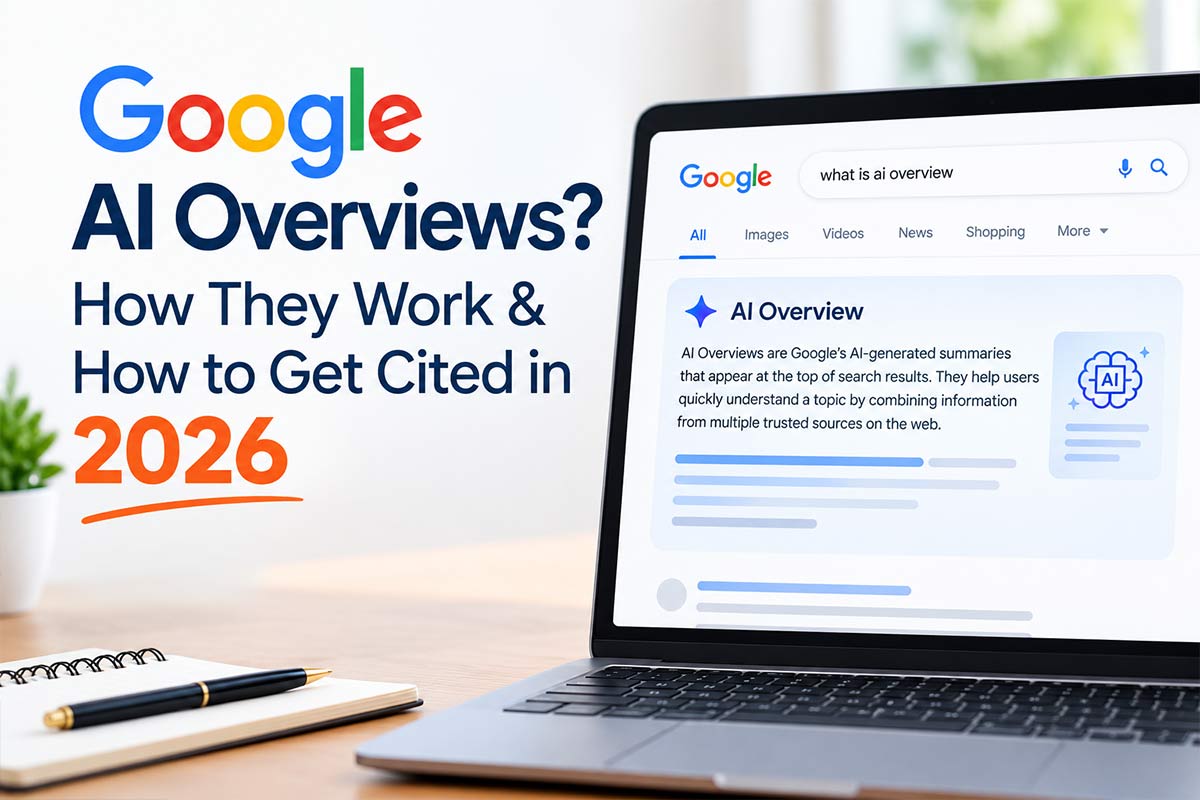
Google AI Overviews are the AI-generated summaries that now appear at the very top of many Google search results, above the traditional “10 blue links.” If your business’s content isn’t structured to be pulled into these summaries, you can rank on page one and still lose the click before a searcher ever sees your listing. This guide explains exactly how AI Overviews work, how often they show up, and what you can actually do to get your content cited in 2026.
What Are Google AI Overviews?
An AI Overview is an AI-generated answer that appears in a dedicated box near the top of Google’s search results, summarizing information from multiple web sources in response to a search query. Unlike a traditional featured snippet, which pulls one exact passage from one page, an AI Overview synthesizes information from several sources into a single written answer, then lists the sources it drew from as clickable links below or beside the summary.
They are powered by Google’s Gemini large language model, which generates the summary text and then pairs it with citations pulled from Google’s own organic search index – most AI Overviews cite sources that are already ranking within the top 35 organic positions for that query, and commonly draw from the top 12 results specifically (source: Botify).
How Common Are AI Overviews Right Now?
AI Overviews aren’t a rare, occasional feature anymore – they now appear in roughly 20% of Google searches globally, though this varies heavily by market and topic. They show up far more often for informational queries (around 59% of informational searches) than for commercial, buying-intent searches (around 19%). Longer, more specific search queries also trigger AI Overviews more often than short, one-word searches.
Adoption also varies sharply by industry. Health-related searches trigger AI Overviews about 60.7% of the time, and Home and Garden queries about 50.4% of the time, while Local Services and Real Estate queries trigger them far less often, around 2-5%. If you run a local business, this means the impact on your industry may be smaller than the headlines suggest – but it’s growing every quarter, so it is worth preparing for now rather than later.
Why AI Overviews Matter for Your Business
The biggest impact of AI Overviews isn’t visibility – it’s clicks. Research shows the presence of an AI Overview correlates with a 34.5% lower average click-through rate for the top-ranking page on that search. On desktop, clicks can drop by as much as 64.4%; on mobile the decline is closer to 30%. Only about 8% of users click through to a website when an AI Overview is present, compared to 15% when it isn’t (source: SeoProfy).
In other words, ranking #1 the old way is no longer enough on its own. If Google’s AI is answering the question directly in the search results, and your site isn’t one of the cited sources, you can lose the visit entirely – even from a query you technically “rank” for. This is exactly why more businesses are now investing in Generative Engine Optimization (GEO) alongside traditional SEO, treating AI citation as its own ranking goal rather than an afterthought.
How Does Google Decide What to Cite in an AI Overview?
Google’s AI Overviews draw their citations from pages that are already performing well organically, then apply a few additional filters:
- Existing rankings matter most. The vast majority of cited pages already rank in the top 10-35 organic results for the query – AI Overviews rarely surface content that isn’t already earning strong rankings through normal SEO.
- Content diversity is rewarded. If the top-ranking pages for a query all say essentially the same thing, Google’s system looks further afield – including at closely related queries – to find a source that adds something different.
- Concentration among established sites is real, but not total. Data from Ahrefs shows the top 50 domains account for roughly 28.9% of all AI Overview citations – meaning large, established sites do get cited disproportionately, but more than 70% of citations still go to smaller and mid-sized sites that publish genuinely useful, specific content.
- Clear, well-structured answers get pulled more easily. Content that states a direct answer plainly, in a format the AI can lift cleanly (a short definition, a numbered list, a table), is easier for the system to extract and cite accurately.
How to Get Your Content Cited in Google AI Overviews (2026)
There is no separate “trick” to winning AI Overview citations that bypasses good SEO – the two are deeply connected. Here is a practical, 6-step approach:
- Rank well organically first. Since most AI Overview citations come from pages already ranking in the top 10-35 results, solid keyword research, on-page optimization, and technical SEO remain the foundation. If your SEO isn’t strong, AI citation is unlikely regardless of anything else you do.
- Answer the question directly, early in the page. Open each section with a clear, direct answer in plain language (40-60 words) before going into detail. This is the format AI systems can extract and cite most reliably.
- Add information the AI can’t already get elsewhere. Original data, first-hand experience, case studies, or a genuinely different angle on the topic – what’s often called “information gain” – increases your odds of being the source Google reaches for when it wants to add diversity to an answer.
- Structure content for extraction. Use descriptive headings phrased as questions, numbered steps for processes, bullet lists for comparisons, and tables for data – all of these are easier for an AI system to lift cleanly into a summary than long, unbroken paragraphs.
- Strengthen E-E-A-T signals. Show real experience, expertise, and authority – author bios, credentials, case studies, and genuine business information all help both traditional rankings and AI trust signals.
- Add structured data (schema markup). FAQPage, HowTo, and Article schema help both traditional search engines and AI systems understand exactly what your content answers, which questions it covers, and how it’s organized.
What About “Google’s AI” More Broadly?
You may also see the broader term “Google’s AI” used to describe everything from AI Overviews to Gemini integrations across Google Search, Workspace, and Android. For most businesses, the practical takeaway is the same regardless of which specific feature is involved: Google’s search experience is shifting from a list of links toward AI-generated answers, and the sites that keep earning visibility are the ones that combine strong fundamental SEO with clear, well-structured, genuinely useful content. Rather than chasing every individual AI feature Google ships, focus on the fundamentals above – they carry over to whatever Google’s AI search products look like next.
How Duggal Infotech Helps Amritsar Businesses Get Cited by AI Search
Getting cited in AI Overviews starts with the same groundwork as ranking well in traditional search – which is exactly what our digital marketing services in Amritsar are built around. We combine technical SEO, keyword-mapped content marketing, and structured data (FAQ, HowTo, and Article schema) on every page we build or optimize, so your content is positioned to earn both organic rankings and AI citations rather than one at the expense of the other.
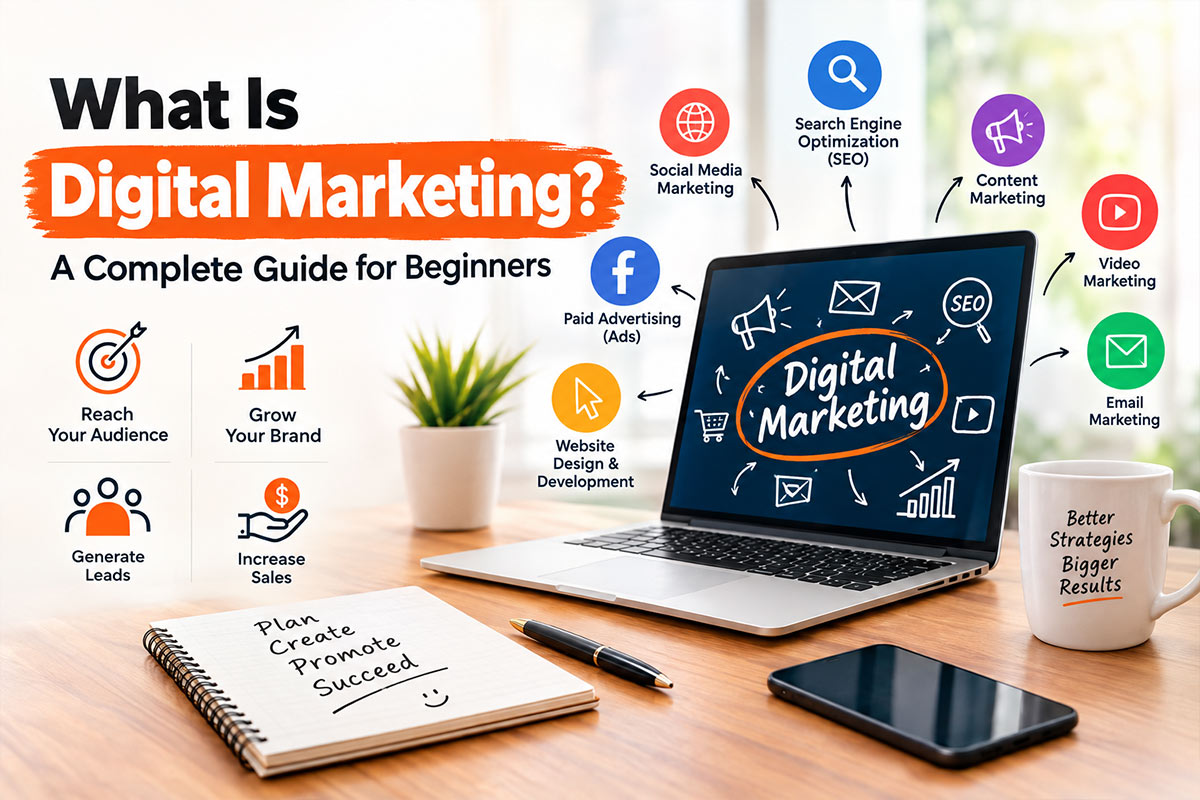
If you’re starting from scratch on your content strategy, our guide on what digital marketing is and how it works is a good foundation, and our breakdown of what a digital marketer actually does explains the skill set needed to execute this kind of work well.
Frequently Asked Questions
What is a Google AI Overview?
A Google AI Overview is an AI-generated summary that appears near the top of Google’s search results, synthesizing information from multiple web sources into a single answer and citing the sources it drew from.
How does Google decide which sites to cite in AI Overviews?
Google’s AI Overviews mostly cite sites that already rank well organically, typically within the top 10-35 positions, then favor sources that add unique information or diversity when top-ranking pages are too similar to each other.
Do AI Overviews reduce website traffic?
Yes, in many cases. Studies show AI Overviews correlate with a roughly 34.5% lower click-through rate for the top-ranking result, since users increasingly get their answer directly in the search results without needing to click through.
How often do AI Overviews appear in search results?
AI Overviews currently appear in roughly 20% of Google searches globally, though this varies significantly by industry and query type – informational searches trigger them far more often than commercial or local searches.
What is the difference between AI Overviews and featured snippets?
A featured snippet extracts one exact passage from a single web page, while an AI Overview generates a new, synthesized answer using Google’s Gemini model, often drawing on and citing several different sources at once.
Can small businesses get cited in AI Overviews, or only big brands?
Small and mid-sized sites can absolutely get cited. While the top 50 domains account for a notable share of citations, the majority of AI Overview citations still go to smaller sites that publish specific, well-structured, genuinely useful content.
What is Generative Engine Optimization (GEO)?
Generative Engine Optimization (GEO) is the practice of structuring and writing content specifically so that AI systems like Google AI Overviews, ChatGPT, and Perplexity can understand, trust, and cite it in their generated answers.
Does adding schema markup help with AI Overviews?
Yes. FAQPage, HowTo, and Article schema help both traditional search engines and AI systems clearly understand what a page covers and how it’s structured, which supports both organic rankings and AI citation.
Should I stop investing in traditional SEO because of AI Overviews?
No. Since most AI Overview citations come from pages that already rank well organically, traditional SEO remains the foundation – AI citation is best treated as an additional goal layered on top of solid SEO, not a replacement for it.